Françoise Merle
Les Choses humainesFrançoise Merle, a celebrated journalist and Jean Farel’s long-term partner, is the person Jean repeatedly loves in private but refuses to choose in public. Her career, independence, and eventual illness give the cost of that refusal a life beyond his self-image: after nearly eighteen years of waiting, she decides that leaving him is necessary for her survival, and later loses both physical strength and the memory that once bound their shared history.##Identity and professional life Françoise began in the society section of a major daily newspaper and rose through the newsroom, becoming a reporter, editor-in-chief, deputy editorial director, and editorial director. She won the Albert-Londres Prize in the 1970s for an exceptional report, “Les Oubliés de la cité Palacio,” about a housing estate in Seine-Saint-Denis. The career that had once carried her to the top of the profession did not end with a formal dismissal: after losing an election for the paper’s directorship, she was recast as an editorial adviser, an obscure title that spared the institution from confronting her marginalization directly.
For two years, the unofficial sidelining became a source of depression. Françoise still felt effective and competent, but understood that the new role presaged retirement and the professional disappearance she dreaded. She took anxiolytic medication to endure the disgrace of being pushed out while still believing she had work to do. Her career thus gives a particular force to the novel’s concern with aging and visibility: the loss is not simply a title, but the removal of a capable woman from the field in which she had earned authority.
A long relationship kept in the shadows
Jean met Françoise three years after the birth of his son, Alexandre, in the corridors of Ambition pour tous, an association Jean had founded to help students from disadvantaged backgrounds enter journalism schools. Françoise was then a beautiful, cultured, generous journalist. She was sixty-eight when the narrative describes her, and she had been Jean’s hidden partner for nearly eighteen years. During that time, she did not marry or have a child; she waited for Jean, who repeatedly promised that they would one day be together.
Jean’s reasons for remaining married were bound up with the family structure he wanted to preserve for Alexandre. He said he lacked the courage to divorce, less from continuing interest in Claire than from a desire to give his son a stable, balanced home. Yet he also treated his marriage as a public asset: he and Claire appeared in magazines as a faithful couple and devoted parents, a carefully staged image that supported his standing. Françoise saw those articles in the press. In moments of distress she broke with Jean, while he kept asking her to accept a private attachment that his public life would not acknowledge.
The imbalance was sharpened by Jean’s anxiety about age and reputation. He considered building a new life with a younger woman from the television world, imagining a bargain in which she would gain security and access to media while he borrowed youth and sexual vitality from her. He recognized that such an exchange was not love. But he did not leave Françoise either: he was attached to her and could not break the bond without feeling he would destroy himself, while also believing that appearing beside a woman nearly his own age would damage his image. She remained both the partner he loved and the person he refused to make visible.
Betrayal and the decision to leave
The contradiction became acute when Jean’s portrait appeared in Françoise’s newspaper alongside a damaging account of his conflict with Michel Duroc. Jean believed Françoise had betrayed him by allowing the article to run. She told him she had not seen it before publication and that the layout had been changed without her knowledge; she had already warned him that the portrait could backfire. Her apology did not prevent Jean from accusing her of betrayal. The scene brings their private relationship into the same machinery of reputation that governed his public life: Françoise’s professional position became entangled with his demand for loyalty, even though she said she had neither controlled nor known about the final article.
After Françoise attempted suicide, Jean received the news while at the Élysée for the ceremony at which he was to become a Grand Officer of the Legion of Honour. He froze, feared that he would suffer another stroke in front of the assembled guests, and regretted how harshly he had treated her. Seeing Claire in the dress Jean had asked her to wear, he thought that Françoise was the only woman he had loved and that she had tried to die because of him. But the ceremony was about to begin; he put away his phone and continued to perform the role expected of him. The honor and its public spectacle stood beside an emergency he could not bring himself to leave the room to address.
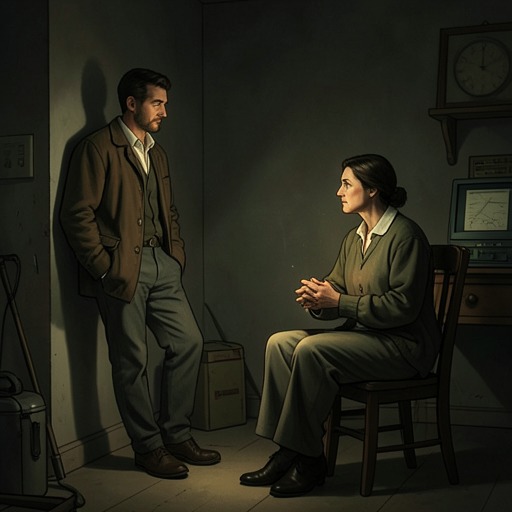
When Jean later came to see her, he approached in a gentler mood, touched her hand, and apologized for having been brutal and foolish. Françoise did not answer at first. She had built her life around freedom and independence and knew she had to leave him for the sake of her mental and physical survival; she had already been taken too far beyond her limits. Jean asked her to speak, and she named the distinction he had evaded throughout their relationship: he had taken professional risks at the heart of the country’s political machinery, but had shown no courage in his private life. His explanation that work had consumed him did not undo the years in which she waited for him to make a choice.
Illness, memory, and the final reversal
By the time of Alexandre’s trial, Françoise’s condition had progressed so far that Jean’s account of the five days of anguish surrounding the verdict would find no recognition in her. After the verdict, he left the courthouse saying he would make no comment to the press. He wanted instead to go to Françoise and tell her what he had endured, though the narrative makes clear that this intimate purpose could no longer reach the person he remembered.
At her apartment in the Second Arrondissement, Jean found Françoise on the floor, trying to push herself upright by gripping a chair. Her arms had lost the muscle needed to lift her. The aide was away and had left a note saying she would return within two hours. Jean struggled to raise Françoise, then guided her slowly to a bathroom fitted with adaptations intended to help her move and prevent a potentially fatal fall. He settled her on a seat, placed her hand on a grab bar, and washed her; a bedsore on her left buttock made the progress of her illness visible on her body. When she opened her eyes, she mistook Jean for her father and asked whether he had brought her sweets. Her irreversible regression had carried their relationship beyond shared memory: he still knew their history, while she could no longer recognize him.
Narrative significance
Françoise’s story measures the distance between Jean’s public courage and private conduct. He can move through the political center of the country, manage his image, and receive a state honor, but spends nearly eighteen years promising a future he does not deliver. His public presentation as a faithful husband and good father depends in part on Claire, while the emotional and temporal cost of his indecision falls on Françoise: she forgoes marriage and children, waits for a commitment, and is left to confront professional exclusion and depression without the shared future he promised.
The novel also gives Françoise a judgment of her own. Her decision to leave is not framed as a change of heart negotiated on Jean’s terms; she identifies the relationship as a threat to her survival and names his lack of private courage. Later, illness makes her increasingly unable to speak from the history the two once shared. That final reversal is stark: Jean arrives wanting to tell her about his fear and grief, but the woman who might once have received that confession no longer knows who he is. Her physical dependence and lost memory do not erase the independence that informed her decision; instead, they expose how little of their shared life Jean can recover through regret alone.